amorphous Simulant amber simulant (natural material)
Copal (Amber Simulant)
Formula Partially polymerised plant resin (labdanoid diterpenes; younger resin; not fully matured/polymerised)
Crystal Structure
 #! Species: Copal (partially polymerised plant resin; amber simulant)
#! System: Amorphous (natural resin)
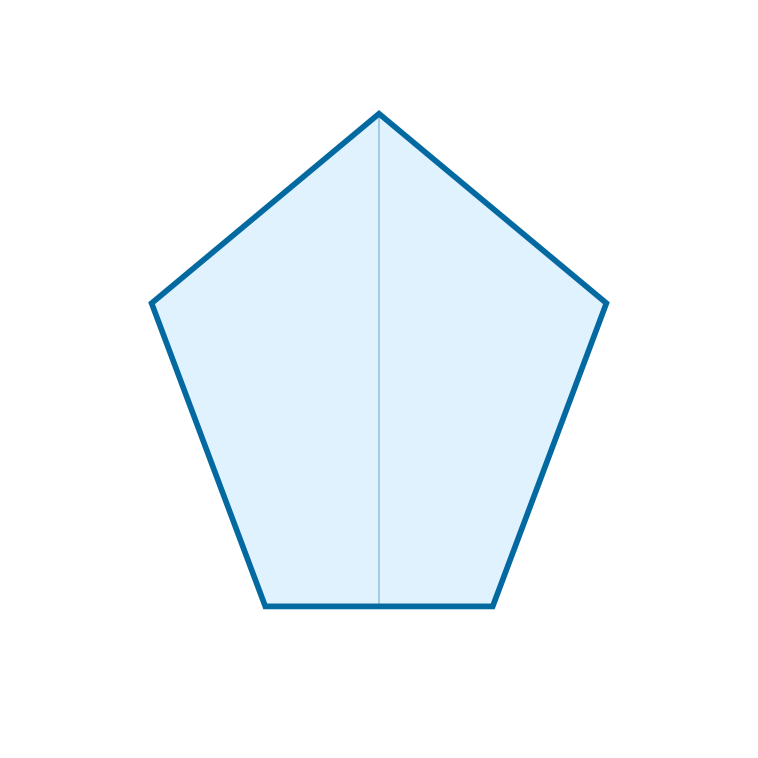
#! Habit: Irregular nodular masses; resinous
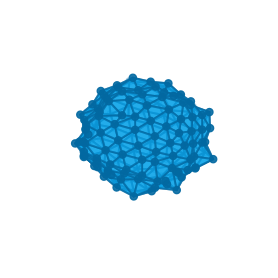
amorphous[resinous]:{nodular}
amorphous
none
{nodular}
Quick Facts
Hardness
1.5
Specific Gravity
1.04
Refractive Index
1.53
Optical Character
Isotropic
Physical Properties
- Crystal System
- amorphous
- Hardness (Mohs)
- 1.5
- Specific Gravity
- 1.04
- Cleavage
- None
- Fracture
- Conchoidal
- Lustre
- Resinous
Optical Properties
- Refractive Index
- 1.53
- Birefringence
- 0
- Optical Character
- Isotropic
- Fluorescence
- Often intense (LWUV; typically brighter than amber, but variable)
Origin & Identification
- Origin
- Simulant
- First Produced
- 0
- Diagnostic Features
- Acetone test: surface becomes tacky/sticky in seconds (amber unaffected — definitive field test); softens at lower temperature (~100-150 C vs amber ~200-250 C); FTIR lacks Baltic amber "shoulder" ~1150 cm-1; inclusions appear fresh/undesiccated; surface crazing develops faster; fluorescence often more intense than amber
Characteristics
Colours
Yellow to yellow-orange (similar to amber); pale yellow; transparent to translucent
Common Inclusions
Modern insects (fresh appearancenot desiccated; diagnostic of recent origin); plant matter (less degraded than amber inclusions)
Notes
Partially polymerised plant resin (<40 Ma; often Holocene to Neogene); not fully matured. Key distinction from amber: acetone test — copal becomes tacky/sticky within seconds; amber (fully polymerised) is unaffected. FTIR: lacks the "Baltic shoulder" at ~1150 cm-1 characteristic of mature succinite amber. Rao et al. 2013, Science China Physics, Mechanics & Astronomy (DOI 10.1007/s11433-013-5144-z) [VERIFIED]: amber vs copal by UV-VIS, infrared and Raman spectroscopy — acetone test and FTIR spectral fingerprint confirmed as diagnostic. Commercial sources: Colombia, Madagascar, East Africa, New Zealand. RI essentially identical to amber (1.530-1.545); SG overlaps amber (1.05-1.10); refractometer and float tests cannot reliably distinguish — acetone and FTIR are required.
Related Minerals
Other minerals in the amorphous system
Ambroid (Pressed Amber)
Compressed and fused amber chips (same chemical composition as amber — fossil resin; succinite for Baltic amber)
Bone (Ivory Simulant)
Ca5(PO4)3(OH) (hydroxyapatite; same general composition as ivory dentine) in collagen matrix; technically microcrystalline hydroxyapatite but gemologically treated as amorphous/aggregate biomineral
Chalcedony (Botryoidal)
SiO2
Chalcedony (Massive)
SiO2
Chrysocolla
(Cu,Al)2H2Si2O5(OH)4.nH2O
Coral
CaCO3 (calcareous; polycrystalline calcite + organic matrix); black coral = gorgonin protein