orthorhombic Synthetic synthetic chrysoberyl
Hydrothermal Alexandrite (Crystal)
Formula BeAl2O4:Cr
Crystal Structure
 #! Species: Hydrothermal Alexandrite
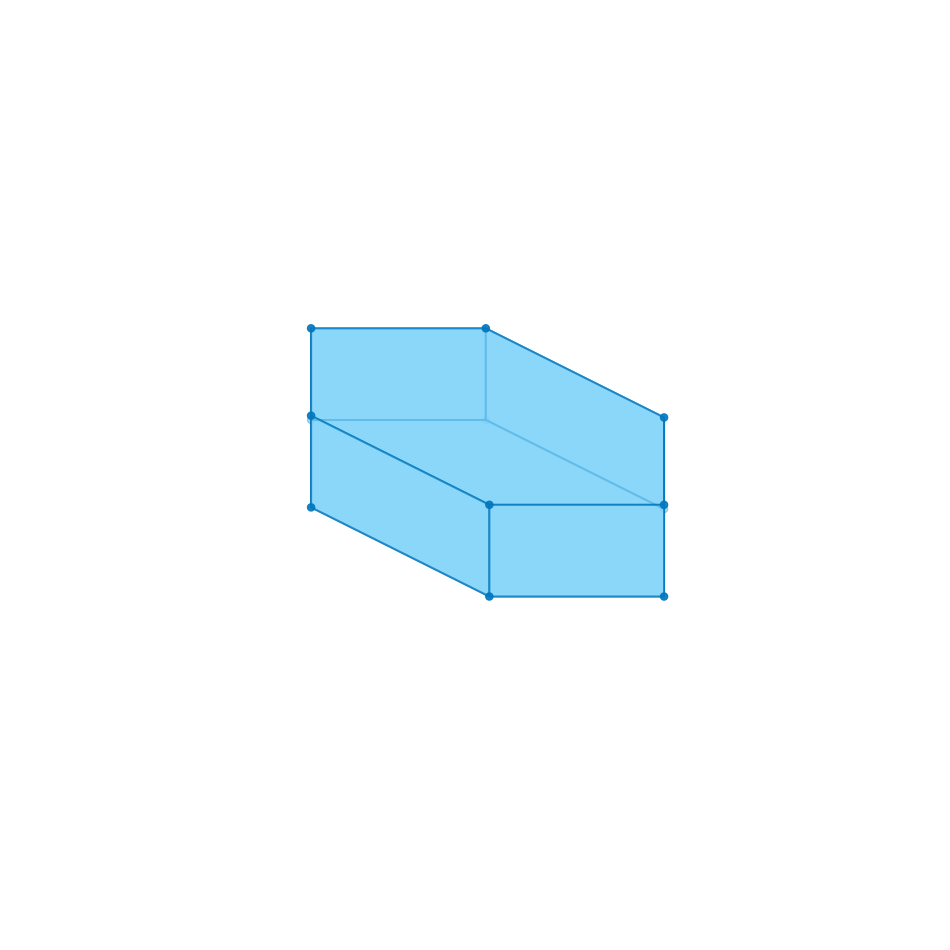
#! System: Orthorhombic (mmm)
#! Habit: Tabular; chevron zoning from autoclave growth
orthorhombic[mmm]:{110}@1.0 + {010}@0.6 + {001}@0.3
orthorhombic
mmm
{110} {010} {001}
Quick Facts
Hardness
None
Specific Gravity
3.7
Refractive Index
1.746
Optical Character
Biaxial +
Physical Properties
- Crystal System
- orthorhombic
- Hardness (Mohs)
- None
- Specific Gravity
- 3.7
- Cleavage
- Distinct {110} in two directions
- Fracture
- Conchoidal
- Lustre
- Vitreous
Optical Properties
- Refractive Index
- 1.746
- Birefringence
- 0.009-0.010
- Optical Character
- Biaxial +
- Dispersion
- 0.015
- Pleochroism
- strong: Green (daylight/fluorescent) / Red to purplish-red (incandescent)
- Fluorescence
- Weak to moderate red (LW UV)
Origin & Identification
- Origin
- Synthetic
- Growth Method
- Hydrothermal (autoclave; Aqueous Mineraliser Solution; Seed Plate Of Natural Or Synthetic Chrysoberyl; Growth Over Weeks At High T/P)
- Manufacturer
- Tairus Joint Enterprise (Novosibirsk, Russia); Biron (Australia); Regency (Thailand/Australia)
- First Produced
- 1990
- Diagnostic Features
- Chevron (herringbone) zoning — most characteristic growth feature; Cr colour zoning follows chevron growth fronts of autoclave-grown crystal in a V-pattern parallel to seed plate; visible under microscope with diffuse lighting; seed plate — visible (or implied by growth geometry) junction between seed and overgrown material; nail-head spicules — short nail-head-shaped two-phase inclusions (liquid + gas) oriented perpendicular to growth layers; characteristic of hydrothermal growth under high pressure; absence of flux inclusions (no Pt platelets; no flux veils — distinguishes from flux-grown); wavy growth planes (hydrothermal growth planes visible as wavy parallel lines under immersion); EDXRF: high purity; absence of Fe distinguishes from natural and Czochralski
Characteristics
Colours
Green (daylight)Red to purplish-red (incandescent)
Common Inclusions
Chevron growth zoning (Cr colour)Seed plate junctionNail-head spicules (two-phase)
Notes
Hydrothermal alexandrite from Tairus (Novosibirsk), Biron (Australia), and Regency. Peretti, Mullis, Mouawad & Guggenheim 1997, Journal of Gemmology 25(8):540 (DOI 10.15506/jog.1997.25.8.540) [VERIFIED]: inclusions in hydrothermal rubies and sapphires from Tairus (Novosibirsk); diagnostic suite applies by analogy to hydrothermal alexandrite from same manufacturer. Russian flux-grown alexandrite diagnostics confirmed by Schmetzer et al. 1996 (DOI 10.5741/gems.32.3.186) [VERIFIED] for comparison. Three-way distinction: Czochralski (curved striae + iridium inclusions); flux (Pt platelets + flux veils); hydrothermal (chevron zoning + nail-head spicules + seed plate).
Natural Counterpart
The natural gem this synthetic imitates
Related Minerals
Other minerals in the orthorhombic system