trigonal Synthetic synthetic corundum
Hydrothermal Ruby (Crystal)
Formula Al2O3:Cr
Crystal Structure
 #! Species: Hydrothermal Ruby
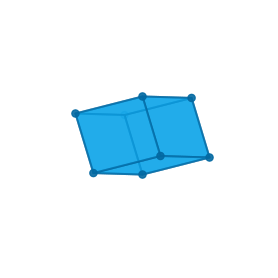
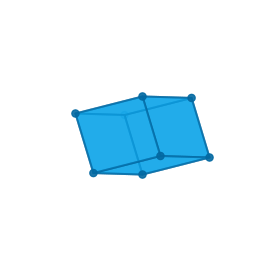
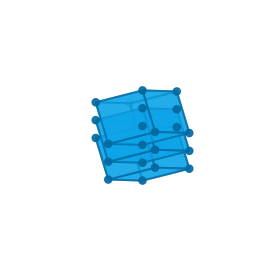
#! System: Trigonal (-3m)
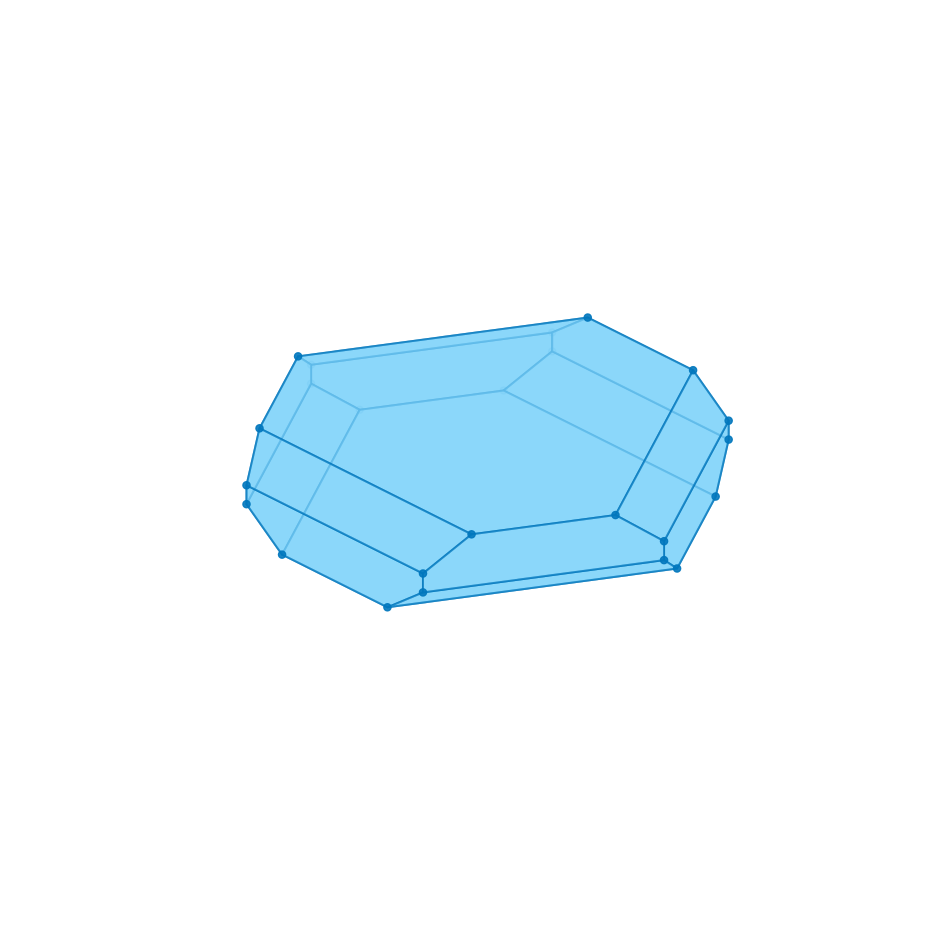
#! Habit: Tabular to prismatic; seed plate base; chevron Cr zoning
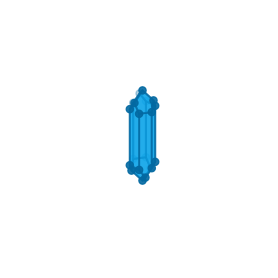
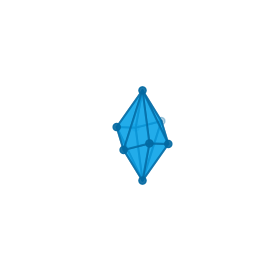
trigonal[-3m]:{10-10}@1.0 + {10-11}@0.8 + {0001}@0.5
trigonal
-3m
{10-10} {10-11} {0001}
Quick Facts
Hardness
None
Specific Gravity
3.99
Refractive Index
1.762
Optical Character
Uniaxial -
Physical Properties
- Crystal System
- trigonal
- Hardness (Mohs)
- None
- Specific Gravity
- 3.99
- Cleavage
- None (parting on {0001} and {10-11})
- Fracture
- Conchoidal
- Lustre
- Vitreous to adamantine
Optical Properties
- Refractive Index
- 1.762
- Birefringence
- 0.008
- Optical Character
- Uniaxial -
- Dispersion
- 0.018
- Pleochroism
- strong: purplish-red / orangey-red
- Fluorescence
- Strong red (LW and SW UV; same as natural Burma ruby)
Origin & Identification
- Origin
- Synthetic
- Growth Method
- Hydrothermal (autoclave; Aqueous HF/chloride Mineraliser; Cr Dopant; Seed Plate Of Natural Or Synthetic Corundum; 400-500 Degrees C / >1 Kbar)
- Manufacturer
- Tairus Joint Enterprise (Novosibirsk, Russia); Biron (Perth, Australia)
- First Produced
- 1985
- Diagnostic Features
- Hexagonal seed plate — clearly visible junction between seed crystal and hydrothermal overgrowth; the seed may have different colour intensity or inclusion suite; plate is typically hexagonally oriented parallel to c-axis of corundum; chevron (herringbone) Cr zoning — Cr colour distributed in chevron-pattern waves perpendicular to growth direction; two-phase inclusions (feathers) — liquid + gas forming irregular feather patterns; differ from natural marble-hosted ruby feathers (which contain calcite or apatite daughters); nail-head spicules — short perpendicular needles with rounded heads from hydrothermal overpressure; absence of natural ruby inclusions (no rutile silk, no calcite, no apatite, no zircon, no natural negative crystals); trace element: very low Fe (<50 ppm typically; natural ruby always >100 ppm Fe); occasionally Nb trace from autoclave walls
Characteristics
Colours
RedPinkish-red
Common Inclusions
Hexagonal seed plate junctionChevron Cr colour zoningNail-head spicules (two-phase)Two-phase fluid feathers
Notes
Hydrothermal ruby from Tairus (Novosibirsk) and Biron (Perth). Two API-verified papers: Peretti et al. 1997, Journal of Gemmology 25(8):540 (DOI 10.15506/jog.1997.25.8.540) [VERIFIED]: inclusions in hydrothermal rubies from Tairus; seed plate, nail-head spicules, chevron zoning documented. Muhlmeister et al. 1998, Gems & Gemology 34(2):80 (DOI 10.5741/gems.34.2.80) [VERIFIED]: "Hydrothermal rubies can be separated from natural rubies by their low iron content and by trace amounts of niobium that are sometimes present from the autoclave walls." Distinguishes from Kashan flux ruby (Pt platelets, angular flux masses, Mo trace) and from Verneuil (curved striae, gas bubbles).
Natural Counterpart
The natural gem this synthetic imitates
Related Minerals
Other minerals in the trigonal system