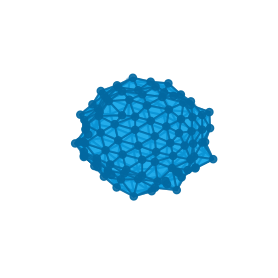
amorphous Phosphates
Turquoise (Massive (typical))
Formula CuAl6(PO4)4(OH)8.4H2O
Crystal Structure
 #! Species: Turquoise
#! System: Amorphous (cryptocrystalline)
#! Habit: Massive and nodular aggregates
amorphous[cryptocrystalline]:{massive, nodular}[colour:blue]
amorphous
-1
{massive, nodular}
Quick Facts
Hardness
5.0
Specific Gravity
2.6
Refractive Index
1.61
Optical Character
Biaxial +
Physical Properties
- Crystal System
- amorphous
- Hardness (Mohs)
- 5.0
- Specific Gravity
- 2.6
- Cleavage
- Good {001}, poor {010}
- Fracture
- Conchoidal to smooth
- Lustre
- Waxy to sub-vitreous
Optical Properties
- Refractive Index
- 1.61
- Birefringence
- 0.04
- Optical Character
- Biaxial +
- Pleochroism
- None (typically aggregate)
Characteristics
Colours
Sky blue (Persian blue - most valued)Blue-greenGreenish-blueApple greenWith matrix patterns
Localities
Iran (Nishapur - finest Persian blue)USA (Arizona, Nevada, New Mexico)Egypt (Sinai - historic)China (Hubei)TibetMexico
Known Treatments
Stabilization (most material)Wax/oil impregnationZachery processDyeingReconstitution
Crystal Forms
massivenodularveins
Notes
Most commercial turquoise is stabilized; untreated gem-quality material commands premium prices
Synthetics & Simulants
Known synthetic and simulant versions of Turquoise
Related Minerals
Other minerals in the amorphous system
Ambroid (Pressed Amber)
Compressed and fused amber chips (same chemical composition as amber — fossil resin; succinite for Baltic amber)
Bone (Ivory Simulant)
Ca5(PO4)3(OH) (hydroxyapatite; same general composition as ivory dentine) in collagen matrix; technically microcrystalline hydroxyapatite but gemologically treated as amorphous/aggregate biomineral
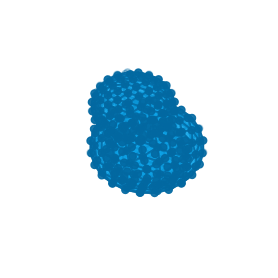
Chalcedony (Botryoidal)
SiO2
Chalcedony (Massive)
SiO2
Chrysocolla
(Cu,Al)2H2Si2O5(OH)4.nH2O
Copal (Amber Simulant)
Partially polymerised plant resin (labdanoid diterpenes; younger resin; not fully matured/polymerised)